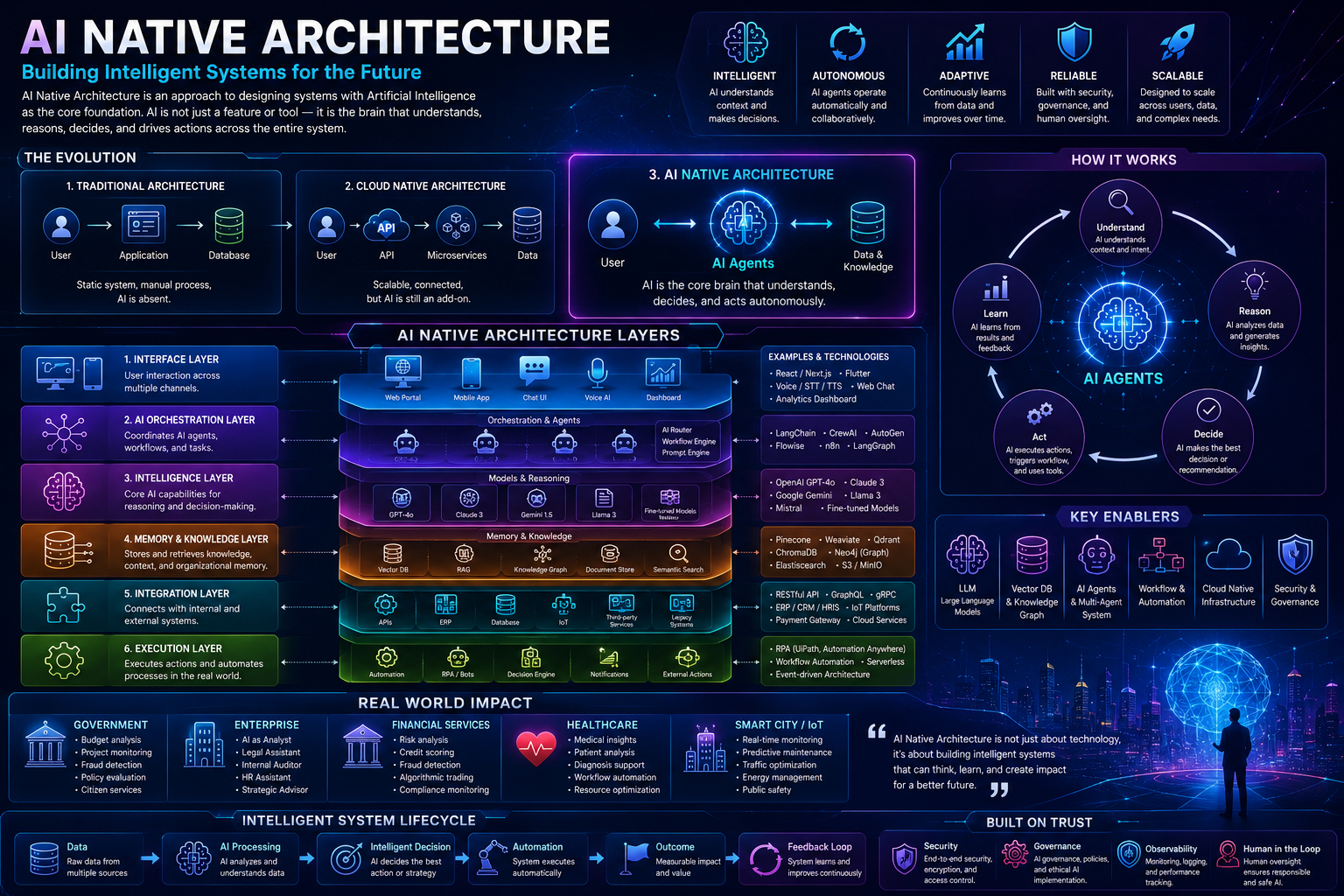
For more than two decades, digital transformation has focused on building systems that are faster, more connected, and more efficient. But today, the technology world is entering a much bigger phase: the era of AI Native Architecture.
This is not simply about adding chatbots into applications or integrating AI features into dashboards. AI Native Architecture represents a completely new approach to building digital systems — one where Artificial Intelligence becomes the core foundation of the entire architecture.
In traditional systems, software only executed instructions written by humans. In AI Native systems, technology begins to understand context, analyze data, make decisions, and even execute workflows autonomously.
From Cloud Native to AI Native
Over the last decade, the technology industry has been dominated by the concept of Cloud Native Architecture. Systems were designed using microservices, containers, Kubernetes, and APIs to achieve scalability and flexibility.
AI Native Architecture introduces a different paradigm.
In conventional architectures, AI is usually treated as an additional feature, such as:
customer service chatbots,
recommendation engines,
or basic analytics tools.
In AI Native systems, AI becomes the “brain” of the platform itself.
Modern architectures are increasingly evolving into structures like:
User ↔ AI Agents ↔ Memory ↔ Tools ↔ Automation ↔ Data
This means AI is no longer limited to answering questions. It now acts as:
an analyst,
a decision-maker,
a workflow operator,
and even a coordinator between systems.
When Systems Begin to “Reason”
One of the most significant differences between AI Native Architecture and traditional systems is reasoning capability.
Traditional software operates through rigid rules defined by developers. When business conditions change, humans must manually update the logic.
AI Native systems work differently. They are adaptive, context-aware, and capable of generating decisions based on constantly evolving data.
For example:
AI can read and classify documents automatically,
analyze financial or operational risks,
detect transaction anomalies,
and recommend actions in real time.
This is why many organizations are moving beyond simple workflow automation toward what is now called intelligent automation.
The Rise of AI Agents
Within AI Native Architecture, the concept of AI Agents becomes central.
AI Agents are autonomous AI entities designed to perform specific tasks independently. Inside a modern digital organization, multiple agents can collaborate with one another.
Examples include:
Finance Agents,
Legal Agents,
Audit Agents,
Planning Agents,
Monitoring Agents.
Each agent can access data, understand context, use tools, and communicate with other agents to complete objectives collaboratively.
This concept is driving the emergence of what many now call a Digital Workforce — a virtual workforce powered by AI operating continuously in real time.
Memory Becomes a Core Layer
AI Native Architecture also introduces a critical new component: the memory layer.
Modern AI systems are no longer powered solely by Large Language Models (LLMs). They also require memory systems capable of storing organizational knowledge and maintaining contextual understanding over time.
As a result, technologies such as:
Vector Databases,
Retrieval-Augmented Generation (RAG),
Knowledge Graphs,
and Semantic Search
are becoming foundational components of modern AI ecosystems.
With these technologies, AI systems are able not only to generate responses, but also to:
remember historical context,
retrieve internal knowledge,
understand organizational data,
and provide context-aware insights.
The Transformation of Software Engineering
AI Native Architecture is also reshaping software engineering itself.
In the past, developers manually wrote nearly all application logic. Today, AI increasingly assists with:
code generation,
debugging,
documentation analysis,
workflow orchestration,
and rapid prototyping.
As a result, the role of engineers is beginning to shift.
From:
“writing every line of code”
toward:
“orchestrating intelligent AI systems.”
This transformation is giving rise to new concepts such as:
AI Native Engineers,
Agentic Development,
and Vibe Coding.
The Future of Digital Organizations
In the coming years, AI Native Architecture is expected to become the foundation of:
digital governments,
modern enterprises,
smart cities,
financial systems,
healthcare platforms,
education ecosystems,
and autonomous businesses.
Organizations will no longer rely solely on applications. They will operate through intelligent systems capable of thinking, analyzing, and acting.
In government sectors, AI Native systems could support:
budget analysis,
project monitoring,
automated auditing,
fraud detection,
and real-time policy evaluation.
Meanwhile, enterprises may deploy AI as:
business analysts,
legal assistants,
internal auditors,
and strategic advisors.
More Than Just a Technology Trend
AI Native Architecture is not simply another technology trend. It represents a fundamental transformation in how digital systems are designed and operated.
We are entering an era where software is no longer just a tool — but an intelligent entity capable of understanding, reasoning, and taking action.
This shift may ultimately become one of the largest technological transformations since the rise of the internet and cloud computing.
And for organizations that adapt early, AI Native Architecture will not only provide technological advantage — it may become the foundation for an entirely new digital future.