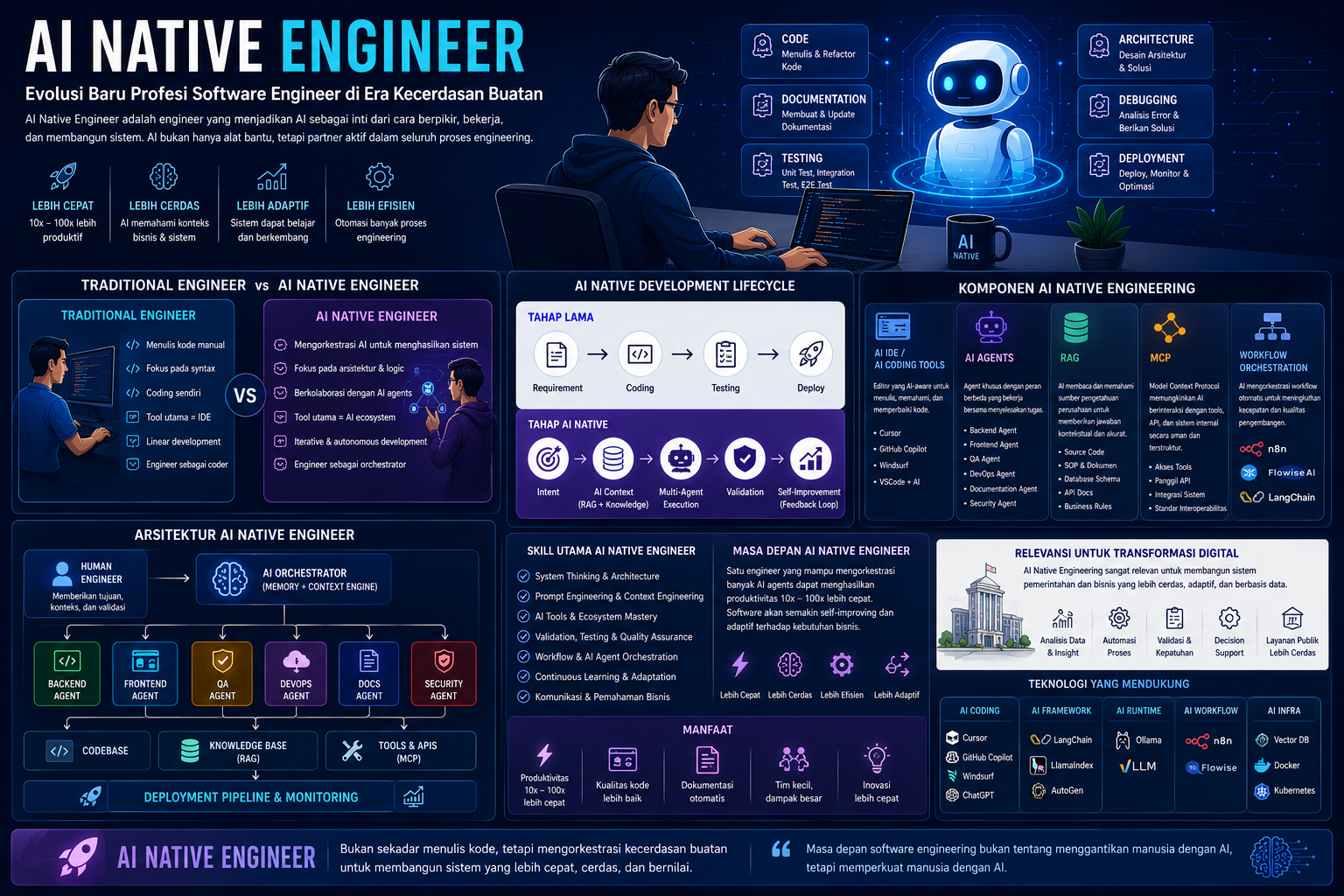
The rapid advancement of artificial intelligence is transforming nearly every industry, and software engineering is no exception. What was once a profession centered around writing code manually is now evolving into something far more intelligent, collaborative, and autonomous. This new era introduces a new type of engineer: the AI Native Engineer.
An AI Native Engineer is not simply a developer who uses AI tools occasionally. Instead, AI becomes a core part of how they think, design systems, build software, solve problems, and accelerate innovation.
What Is an AI Native Engineer?
An AI Native Engineer is a software engineer who works alongside artificial intelligence throughout the entire software development lifecycle. AI is no longer just a coding assistant or autocomplete tool—it becomes an active co-engineer capable of understanding systems, generating code, analyzing architectures, writing documentation, performing testing, and even assisting with deployment and operational monitoring.
In this model, engineers shift from being pure coders into orchestrators of intelligent systems.
The Shift from Traditional Engineering to AI Native Engineering
Traditional software engineering follows a relatively linear workflow: gathering requirements, writing code, testing, debugging, and deploying applications manually.
AI Native Engineering changes this paradigm completely.
Instead of focusing only on syntax and manual implementation, engineers now provide context, intent, business logic, and architectural direction to AI systems. AI can then help generate solutions, automate repetitive work, improve code quality, and accelerate development cycles dramatically.
The role of the engineer evolves from:
writing every line of code manually,
to:designing systems that AI can understand, extend, and improve.
Core Skills of an AI Native Engineer
To thrive in this new era, engineers need a different set of skills.
1. System Thinking and Architecture
AI Native Engineers must understand how entire systems work—not just isolated functions. This includes:
backend services,
frontend architecture,
databases,
APIs,
infrastructure,
security,
and business workflows.
2. Prompt & Context Engineering
One of the most critical skills is the ability to communicate effectively with AI systems. Engineers must learn how to:
provide precise instructions,
define structured context,
design AI workflows,
and guide reasoning processes.
The quality of AI output depends heavily on the quality of context and instructions provided.
3. Validation and Critical Thinking
AI can accelerate development significantly, but human engineers remain responsible for:
validation,
accuracy,
security,
scalability,
and business alignment.
AI Native Engineers must know when to trust AI—and when to challenge it.
4. AI Workflow Orchestration
Modern AI development increasingly involves multiple AI agents working together. Engineers may orchestrate:
Backend AI Agents,
Frontend AI Agents,
QA Agents,
Documentation Agents,
Security Agents,
and DevOps Agents.
The engineer becomes the conductor of an AI-powered engineering ecosystem.
Technologies Powering AI Native Engineering
The rise of AI Native Engineering is supported by a growing ecosystem of tools and frameworks.
AI Coding Platforms
Popular AI-powered development tools include:
These tools help engineers write code faster, understand large codebases, refactor systems, and automate repetitive engineering tasks.
RAG (Retrieval-Augmented Generation)
RAG enables AI systems to understand organizational knowledge by reading:
source code,
internal documentation,
APIs,
SOPs,
database schemas,
and business rules.
This allows AI to provide context-aware and organization-specific responses.
AI Agents
AI agents are specialized AI systems capable of performing focused tasks autonomously, such as:
building APIs,
generating UI components,
running tests,
creating documentation,
or monitoring infrastructure.
MCP (Model Context Protocol)
MCP is becoming an important interoperability layer that allows AI systems to:
access tools,
call APIs,
interact with software ecosystems,
and understand structured operational environments.
Why AI Native Engineering Matters
AI Native Engineering matters because software development speed and adaptability are becoming critical competitive advantages.
Organizations that effectively integrate AI into engineering workflows can:
develop products faster,
reduce operational costs,
improve software quality,
automate documentation,
and scale innovation more efficiently.
In the near future, a single highly capable AI Native Engineer may achieve the productivity previously requiring entire teams.
This does not mean AI replaces engineers. Instead, it elevates engineers into higher-value roles focused on:
strategy,
architecture,
orchestration,
validation,
and innovation.
Relevance for Modern Digital Transformation
AI Native Engineering is highly relevant for businesses, enterprises, startups, and modern digital platforms that aim to build intelligent, scalable, and adaptive systems.
Modern applications are no longer expected to be merely digital—they are expected to be:
intelligent,
automated,
context-aware,
and capable of continuous improvement.
AI-native architectures allow organizations to build systems capable of:
understanding user behavior,
automating workflows,
analyzing large-scale data,
generating insights,
supporting real-time decisions,
and continuously optimizing operations.
This represents a major shift:
from:
“building software manually”
to:
“building intelligent ecosystems powered by AI.”
The Future of AI Native Engineers
The future of software engineering will be deeply collaborative between humans and AI.
Engineers who master AI orchestration, context engineering, and intelligent system design will become some of the most valuable professionals in the technology industry.
In the coming years:
development cycles will become dramatically faster,
autonomous AI agents will become common,
software systems will increasingly self-improve,
and small human teams will build products at unprecedented scale.
The AI Native Engineer will not simply build software.
They will design intelligent ecosystems capable of evolving continuously alongside human creativity and business needs.
Conclusion
AI Native Engineering represents the next major evolution in software development. It combines technical expertise, architectural thinking, AI collaboration, and intelligent automation into a completely new engineering paradigm.
The future belongs to engineers who can work with AI—not against it.
AI Native Engineers are not just coding the future.
They are orchestrating the next generation of intelligent technology.