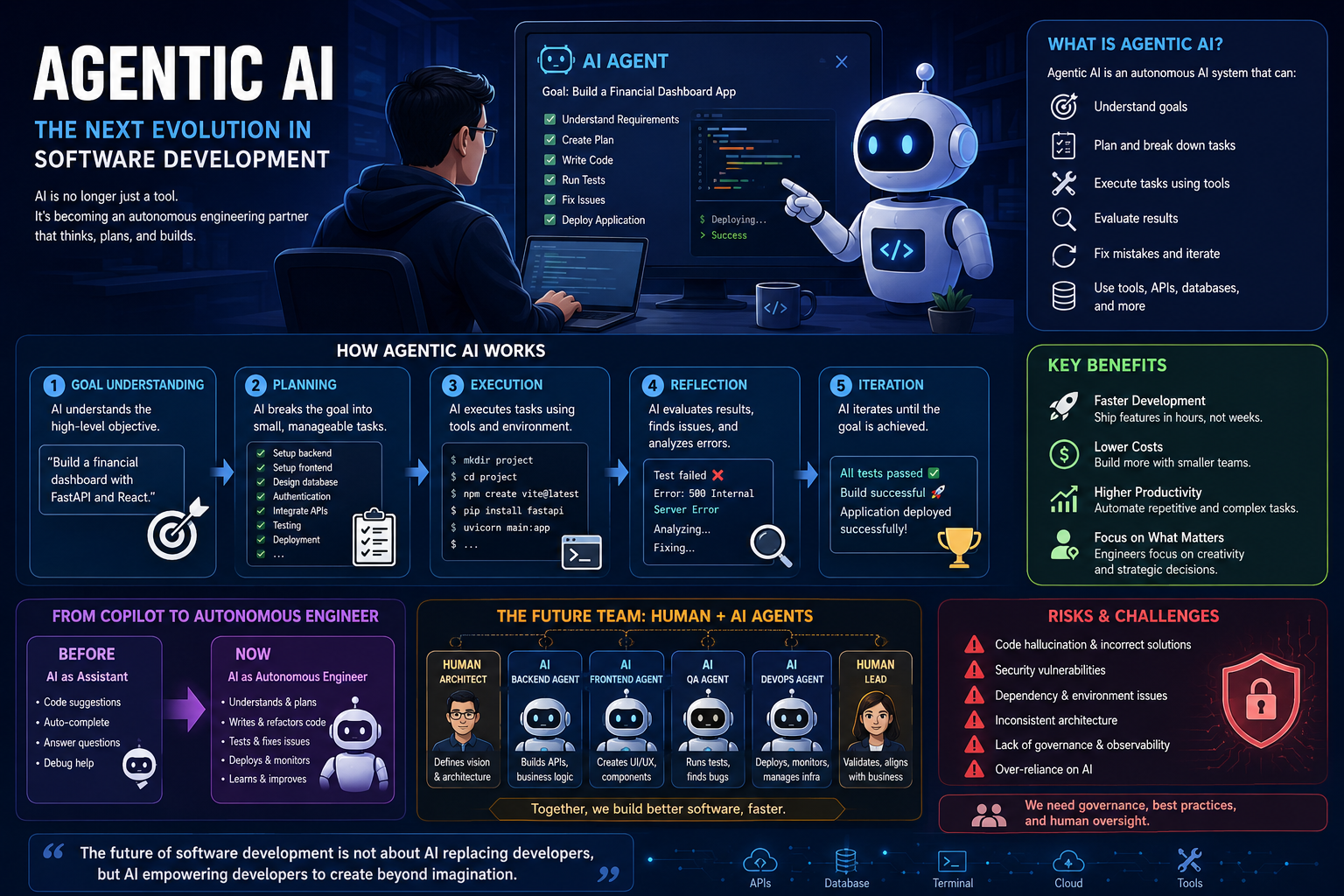
A New Era of Software Development
For years, Artificial Intelligence played only a supporting role in software development—ranging from code auto-completion and simple debugging to syntax recommendations. But today, the technology world is entering a far more transformative phase: Agentic AI.
Agentic AI is not merely an AI that answers questions or generates snippets of code. It is an AI capable of thinking, planning, making decisions, executing complex tasks autonomously, and collaborating like a real software engineer.
If previous generations of AI were like “smart calculators,” Agentic AI is evolving into a true “digital co-worker.”
What Is Agentic AI?
Agentic AI refers to AI systems capable of:
Understanding high-level goals
Creating their own execution plans
Performing multi-step workflows autonomously
Evaluating their own outputs
Correcting mistakes without constant human intervention
Interacting with tools, APIs, databases, terminals, and cloud infrastructure
In the context of software engineering, Agentic AI can:
Create project structures
Develop backend and frontend systems
Design database schemas
Run automated testing
Fix bugs
Deploy applications
Read and understand documentation
Perform code refactoring
Build CI/CD pipelines
Even interpret business requirements
In other words, AI is no longer just “responding to prompts”—it is beginning to act as an active software agent.
From Copilot to Autonomous Engineer
Software development is undergoing a major transformation.
Previously, developers used AI mainly for:
auto-completion
code suggestions
chat-based assistance
Now, a new generation is emerging:
autonomous coding agents
AI software architects
self-improving development workflows
multi-agent engineering systems
Modern tools such as:
Cursor AI
Devin
OpenHands
Claude Code
GitHub Copilot Workspace
SWE-Agent
are demonstrating how AI can perform end-to-end software engineering tasks.
Many AI startups are now racing to build:
“The world’s first true AI Engineer.”
How Agentic AI Works
In simple terms, Agentic AI operates through several stages:
1. Goal Understanding
The AI first understands the primary objective.
Example:
“Build a regional financial monitoring dashboard using FastAPI and React.”
2. Planning
The AI breaks down the large objective into smaller tasks.
For example:
Set up backend architecture
Set up frontend application
Design database schemas
Build authentication systems
Integrate APIs
Perform testing
Handle deployment
3. Execution
The AI starts executing tasks using available tools.
It can:
open terminals
read project files
edit source code
execute commands
install packages
troubleshoot errors
4. Reflection
The AI evaluates its own work.
If issues appear:
it reads error logs
identifies root causes
tests alternative solutions
reruns validation processes
5. Iteration
The AI continuously repeats the cycle until the objective is achieved.
This is what fundamentally differentiates Agentic AI from traditional chatbots.
The Massive Impact on Software Development
Agentic AI is expected to reshape the software industry dramatically over the next 5–10 years.
1. Developers Will Become “AI Supervisors”
Engineers may no longer write every line of code manually.
Human roles will increasingly focus on:
defining architecture
ensuring quality
directing business strategy
supervising AI systems
2. Development Will Become Significantly Faster
Tasks that previously required:
two weeks
multiple engineers
dozens of meetings
could eventually be completed within:
days
or even hours
3. Software Development Costs Will Decrease
Small startups will be able to build highly sophisticated products with minimal teams.
This could accelerate the rise of:
solo-founder unicorns
AI-native companies
hyper-automated software businesses
4. The Rise of “Vibe Coding”
A new phenomenon known as Vibe Coding is gaining popularity.
Developers increasingly:
describe ideas
provide high-level direction
allow AI systems to generate the implementation
Coding is shifting from:
“writing syntax”
to:
“orchestrating intelligent systems.”
However, Agentic AI Comes with Risks
Despite its capabilities, Agentic AI introduces serious challenges.
Potential Risks:
Code hallucination
Security vulnerabilities
Dependency chaos
Inconsistent architecture
Automated overengineering
Reduced observability
Lack of governance in AI-generated code
As a result, organizations are beginning to establish:
AI Coding Governance
Vibe Coding Frameworks
AI Development SOPs
Human-in-the-loop validation systems
to ensure development processes remain controlled and reliable.
The Future: Hybrid Teams of Humans and AI Agents
In the future, software engineering teams may consist of:
RoleResponsibilityHuman ArchitectDefines vision and system architectureAI Backend AgentDevelops backend servicesAI Frontend AgentBuilds UI/UXAI QA AgentHandles automated testingAI DevOps AgentManages deployment & infrastructureHuman LeadFinal validation & business alignment
This hybrid operating model is already being explored by major technology companies worldwide.
Conclusion
Agentic AI is no longer a science-fiction experiment.
It is rapidly evolving into:
an engineering partner
an autonomous developer
a new form of digital workforce
This transformation could become one of the largest revolutions in the history of software engineering.
The question is no longer:
“Can AI help with coding?”
But rather:
“How much of software development will AI eventually take over?”
And the answer may be:
“Much sooner than we expect.”