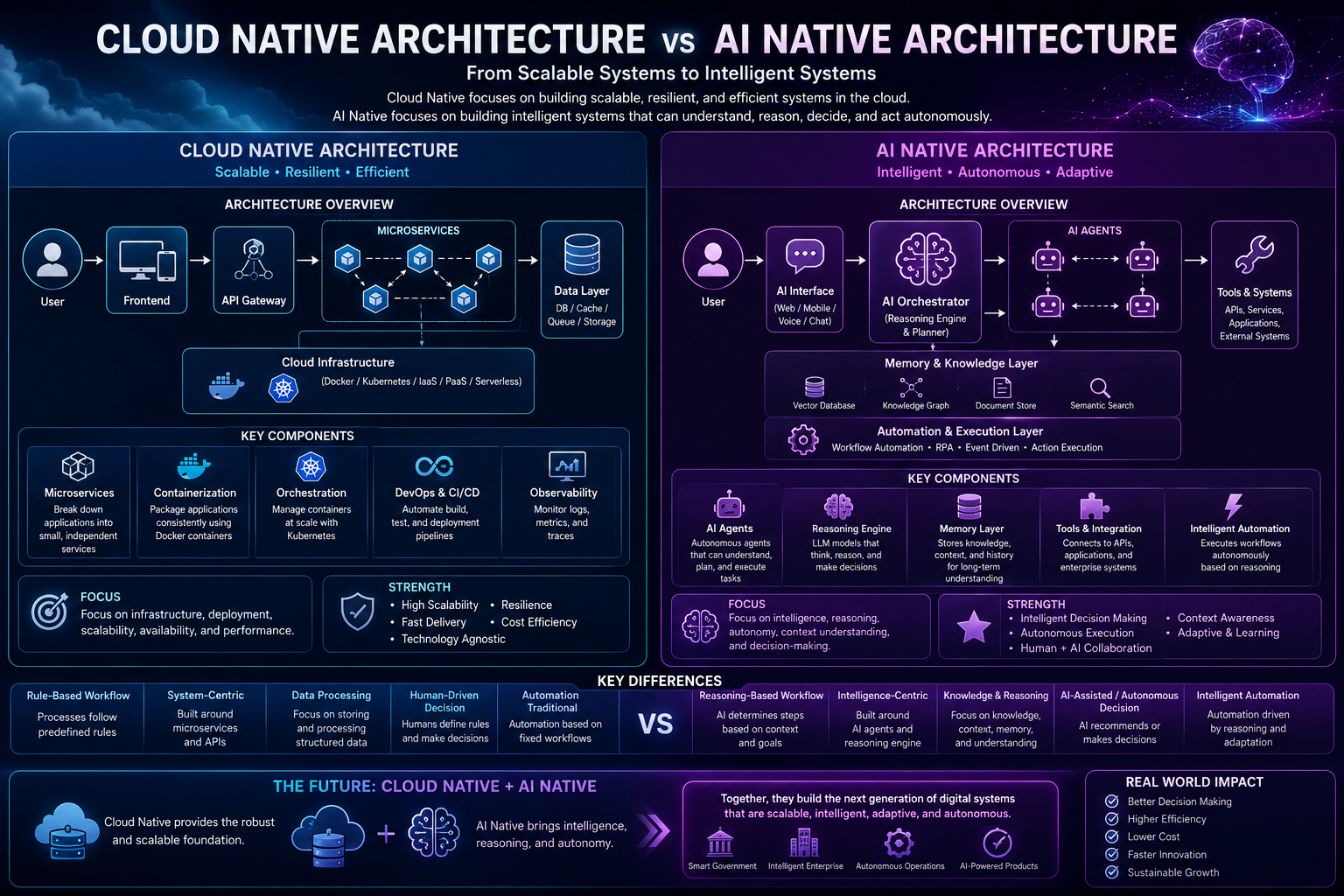
Over the past two decades, the technology industry has undergone a massive transformation in the way digital systems are designed and operated. From traditional monolithic applications, the world moved into the era of Cloud Native Architecture, a paradigm that revolutionized scalability, flexibility, and software delivery.
Today, however, a new architectural wave is emerging — one that may reshape the future of technology even more fundamentally: AI Native Architecture.
Although the two concepts are often mentioned together, Cloud Native and AI Native represent very different philosophies.
Cloud Native Architecture focuses on building highly scalable and resilient systems in the cloud. AI Native Architecture, on the other hand, focuses on building systems that can understand, reason, learn, and make decisions using Artificial Intelligence as the core foundation of the system itself.
This shift is not merely technological. It represents a new stage in the evolution of software engineering.
The Rise of Cloud Native Architecture
Cloud Native Architecture emerged from the growing need to build applications capable of serving millions of users efficiently and reliably. Traditional monolithic systems were difficult to scale, slow to deploy, and risky to maintain. Even small changes could affect the entire application.
Cloud Native Architecture solved many of these challenges by introducing a modern distributed approach built around:
microservices,
containers,
Kubernetes,
APIs,
and automated DevOps pipelines.
Instead of building software as one massive application, systems were broken down into smaller independent services that could communicate through APIs.
This approach enabled organizations to:
scale services independently,
deploy updates rapidly,
improve system resilience,
and optimize infrastructure costs.
Cloud Native became the foundation of modern digital platforms because it allowed businesses to move faster while maintaining stability at scale.
Technologies such as Docker, Kubernetes, and Terraform became central to this movement.
Yet despite all its innovation, Cloud Native systems still relied heavily on predefined logic created by humans.
Software executed instructions.
It did not truly “understand.”
AI Native Architecture: When Intelligence Becomes the Core
AI Native Architecture represents the next evolution.
If Cloud Native transformed how systems run, AI Native transforms how systems think.
In AI Native systems, Artificial Intelligence is no longer treated as an additional feature such as a chatbot or recommendation engine. AI becomes the reasoning layer, the decision-making engine, and the orchestration center of the entire architecture.
This is a major paradigm shift.
Traditional systems operate through hardcoded workflows. Developers define the logic, conditions, and processes manually.
AI Native systems work differently.
Instead of relying solely on static rules, they can:
understand context,
analyze dynamic data,
generate recommendations,
adapt to changing conditions,
and autonomously execute workflows.
For example, AI Native systems can:
read and understand documents,
analyze operational or financial risks,
detect anomalies,
automate approvals,
and coordinate tasks across multiple systems in real time.
The software itself becomes increasingly adaptive and intelligent.
From Microservices to AI Agents
One of the most significant differences between Cloud Native and AI Native Architecture is the emergence of AI Agents.
In Cloud Native systems, the architecture revolves around services.
In AI Native systems, the architecture increasingly revolves around intelligent agents.
AI Agents are autonomous AI entities capable of:
understanding objectives,
reasoning through tasks,
using tools,
accessing data,
and collaborating with other agents.
A modern AI Native organization may contain multiple specialized agents such as:
Finance Agents,
Legal Agents,
Audit Agents,
Planning Agents,
Monitoring Agents.
Together, these agents form what many experts now describe as a Digital Workforce — an intelligent virtual workforce capable of operating continuously across organizational workflows.
This fundamentally changes how businesses and governments may operate in the future.
Memory as a Foundational Layer
Another major difference is the introduction of the memory layer.
Traditional applications primarily store transactional data. AI systems, however, require contextual memory and organizational knowledge.
As a result, technologies such as:
Vector Databases,
Retrieval-Augmented Generation (RAG),
Knowledge Graphs,
and Semantic Search
are becoming essential components of AI Native Architecture.
These technologies allow AI systems to:
remember historical interactions,
retrieve internal knowledge,
understand organizational context,
and provide far more relevant responses and decisions.
In many ways, memory transforms AI from a reactive tool into a continuously learning system.
The Transformation of Software Engineering
AI Native Architecture is also reshaping the role of software engineers.
In previous generations, developers manually wrote nearly every aspect of application logic.
Today, AI increasingly assists with:
code generation,
debugging,
documentation analysis,
workflow orchestration,
testing,
and rapid prototyping.
As a result, engineers are gradually transitioning from:
“software builders”
to:
“AI orchestrators.”
Future engineers may spend less time writing repetitive code and more time designing intelligent workflows, orchestrating AI collaboration, and building organizational knowledge systems.
This transformation is already giving rise to concepts such as:
AI Native Engineers,
Agentic Development,
Autonomous Software Systems,
and Vibe Coding.
The Future: Cloud Native + AI Native
The future of digital systems will likely combine both architectures rather than replace one with the other.
Cloud Native Architecture will continue to provide:
scalability,
resilience,
distributed infrastructure,
and operational efficiency.
AI Native Architecture will provide:
intelligence,
reasoning,
adaptability,
prediction,
and autonomous decision-making.
In other words:
Cloud Native becomes the body of the system.
AI Native becomes the brain of the system.
Together, they create the next generation of digital platforms — systems that are not only scalable and connected, but also capable of understanding, learning, and acting intelligently.
We are entering an era where software is evolving beyond static tools into adaptive digital entities capable of participating in real organizational decision-making.
And this transformation may become one of the most significant technological shifts since the rise of the internet and cloud computing itself.