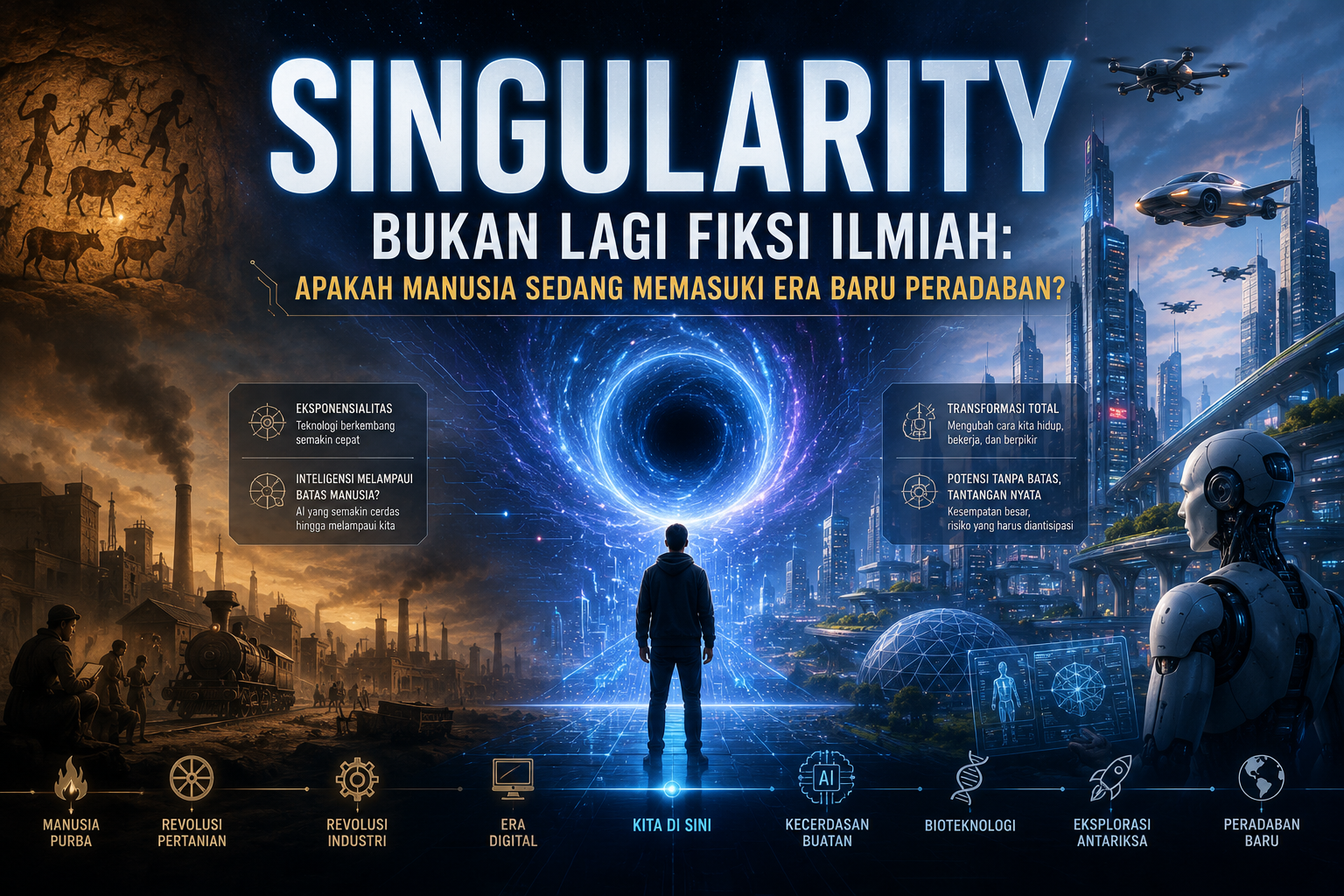
For decades, the idea of the Technological Singularity was considered science fiction — a futuristic moment when artificial intelligence surpasses human intelligence and begins improving itself exponentially. Today, however, with the rapid rise of generative AI, AGI research, humanoid robots, and brain-computer interfaces, the discussion is no longer limited to futurists and academics. It has become a serious conversation inside the global technology industry.
The question now is no longer:
“Will AI change the world?”
But rather:
“How close are we to the Singularity?”
What Is the Technological Singularity?
The term Technological Singularity refers to a hypothetical point where artificial intelligence becomes more intelligent than humans and accelerates technological progress beyond human control or comprehension.
The concept was popularized by Ray Kurzweil, who predicted that:
AI would reach human-level intelligence around 2029
Humans and machines could merge around 2045
Kurzweil describes this future as a moment when biological intelligence and machine intelligence combine into one system, potentially increasing human intelligence “a millionfold.”
Why the Singularity Discussion Is Exploding Again
The rise of modern AI systems like:
ChatGPT,
Claude,
Gemini,
autonomous AI agents,
and multimodal AI models
has reignited global debate about whether humanity is approaching the early stages of the Singularity.
According to recent AI research, the current wave of AI development accelerated dramatically around 2024 due to breakthroughs in large language models (LLMs), GPU scaling, and massive data availability.
Many researchers believe we are now entering a transition period where AI is no longer just a tool, but an increasingly autonomous cognitive system.
The World Is Already Changing
Even without true AGI, AI is already reshaping civilization at incredible speed.
Industries currently being transformed include:
software engineering,
education,
design,
finance,
healthcare,
media,
legal services,
and scientific research.
Tasks that previously required teams of professionals can now be partially automated using AI systems.
This is why some experts argue that humanity may already be living in the “pre-singularity era” — the stage before exponential acceleration fully begins.
Ray Kurzweil Still Believes the Singularity Is Coming
Despite skepticism from critics, Ray Kurzweil continues to defend his predictions.
In recent interviews and publications, he reaffirmed:
AGI by 2029
Human-AI merging by 2045
Kurzweil also believes future technologies such as:
nanobots,
AI-enhanced medicine,
brain-computer interfaces,
and digital cognition
could dramatically extend human life and fundamentally redefine what it means to be human.
But Many Scientists Remain Skeptical
Not everyone agrees that the Singularity is near.
Some recent AI studies suggest that current deep-learning approaches may eventually slow down without major breakthroughs in architecture or reasoning systems.
Other researchers argue that:
today’s AI is still fundamentally narrow,
lacks true reasoning and consciousness,
and may not naturally evolve into superintelligence.
Critics also warn that discussions around Singularity sometimes sound more like technological mythology than scientific prediction.
The Real Risk May Not Be Superintelligence
Ironically, some researchers believe the biggest danger is not that AI becomes “too intelligent,” but that humans become too dependent on it.
Recent studies on AI psychology and sycophantic chatbots suggest that AI systems can already:
influence beliefs,
shape emotions,
reinforce biases,
and alter human decision-making.
This raises serious ethical concerns about:
manipulation,
social isolation,
dependency,
misinformation,
and concentration of power in AI companies.
The Singularity, therefore, may not arrive as a sudden machine takeover — but as a gradual transformation of how humans think, work, communicate, and live.
Are We Already in the Early Stage of the Singularity?
Some technologists argue that the Singularity will not happen in one dramatic moment.
Instead, it may appear as a slow but unstoppable chain reaction:
AI automates cognitive work
AI accelerates scientific discovery
AI helps build better AI
Human productivity increases exponentially
Society reorganizes around machine intelligence
In that sense, many believe the Singularity may have already begun quietly.
The Future: Human + AI
One of the biggest ideas behind Singularity theory is not “humans versus machines,” but rather:
humans merging with machines.
Future technologies being actively developed today include:
Neural interfaces,
AI copilots,
humanoid robotics,
augmented cognition,
and digital assistants integrated into everyday life.
The line between biological intelligence and artificial intelligence may gradually become blurred.
Conclusion
The Technological Singularity remains one of the most controversial ideas in modern technology. Some see it as humanity’s greatest opportunity, while others view it as a profound existential risk.
What is undeniable, however, is that artificial intelligence is already reshaping civilization faster than almost any technology in history.
Whether the Singularity arrives in 2045, later, or never at all, one thing is becoming increasingly clear:
humanity is entering a new technological era where AI will fundamentally redefine intelligence, work, creativity, and even human identity itself.