What Is Vibe Coding?
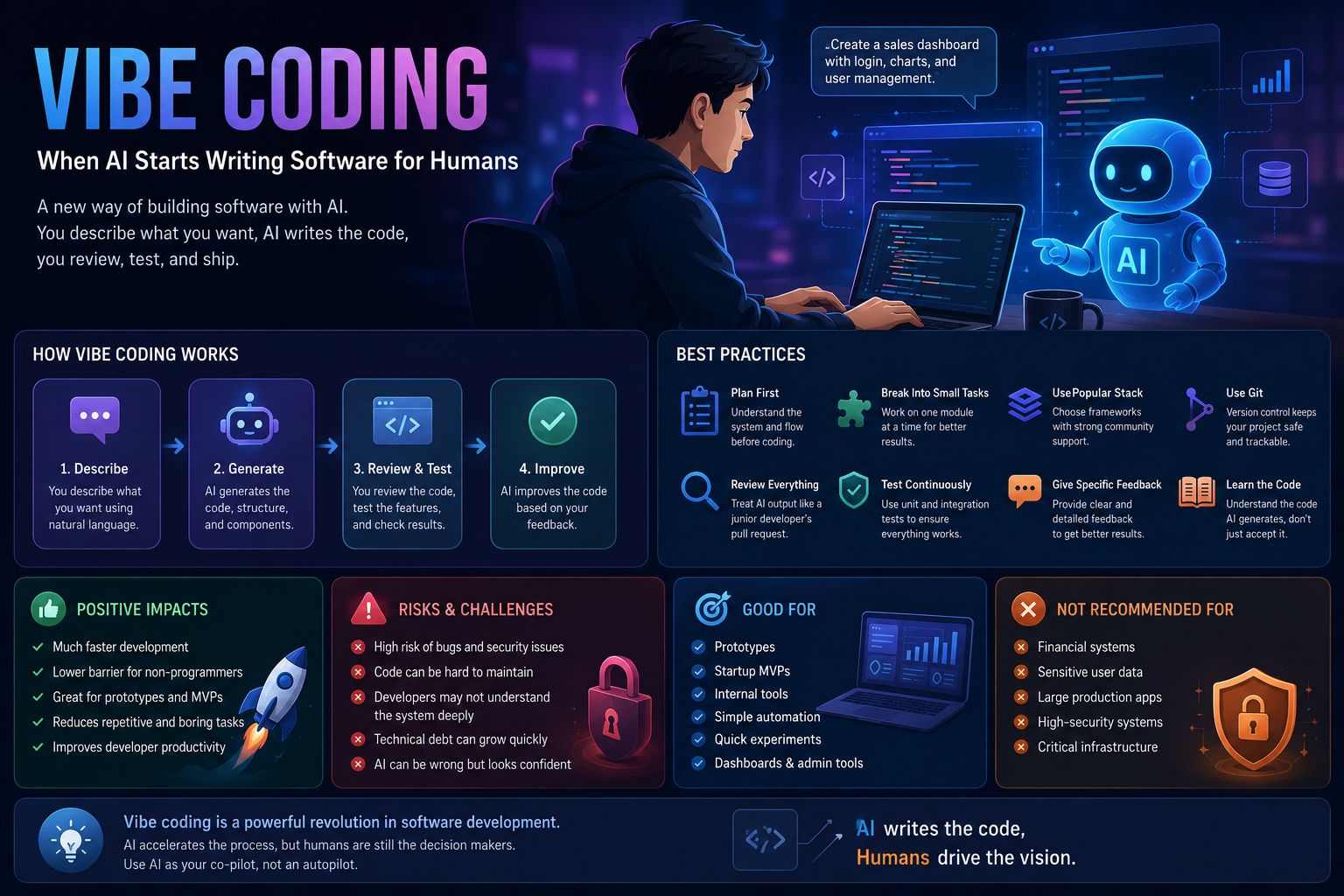
Vibe coding is a modern software development approach where developers describe what they want using natural language, and AI helps generate the code automatically. This concept became increasingly popular alongside the rapid advancement of Large Language Models (LLMs) such as ChatGPT, Claude, Gemini, and Cursor.
The term “vibe coding” was popularized by Andrej Karpathy in 2025. The core idea is simple: humans focus on ideas and business logic, while AI assists in generating application structures, APIs, interfaces, documentation, and repetitive coding tasks.
How Does Vibe Coding Work?
The workflow is generally straightforward:
The developer explains the application requirements using natural language.
AI generates the code based on those instructions.
The developer reviews and tests the output.
AI improves or refines the code based on feedback.
For example:
“Create a sales monitoring dashboard using React and FastAPI with an admin login system.”
AI can then assist in generating:
Project structure
Database models
Backend APIs
Frontend pages
Authentication systems
Basic documentation
Best Practices for Effective Vibe Coding
Although AI can significantly accelerate development, successful vibe coding still requires discipline and engineering practices.
1. Start with Planning
Before asking AI to generate code, developers should prepare a clear system overview, user flow, and feature requirements. AI performs much better when given proper context.
2. Break Tasks into Smaller Parts
Avoid asking AI to build an entire application in a single prompt. It is more effective to divide the project into smaller modules such as:
Authentication
Dashboard
User API
Payment system
Reporting module
3. Use Popular Technology Stacks
Frameworks and tools with strong community adoption are generally better supported by AI because they have more training data available. Examples include:
React
Next.js
FastAPI
Laravel
Supabase
4. Always Use Version Control
Using Git is essential in AI-assisted development. If AI introduces unwanted changes, developers can safely revert to previous working versions.
5. Review Every AI Output
AI-generated code should never be accepted blindly. Developers still need to review, understand, and validate all generated changes.
6. Implement Testing
Testing helps ensure that the system continues to function correctly after AI-generated modifications.
Positive Impacts of Vibe Coding
Faster Development
Tasks that previously required weeks of development can now be completed within hours.
Lower Barrier to Entry
People without deep programming knowledge can now build simple applications using AI assistance.
Reduced Repetitive Work
AI is highly effective for generating:
Boilerplate code
CRUD APIs
Documentation
Form validation
Database schemas
Faster Startup Validation
Many startups now use AI-assisted development to build MVPs and validate ideas much more quickly.
Risks and Challenges
Despite its advantages, vibe coding also introduces serious risks when used without proper supervision.
Security Vulnerabilities
AI may generate code containing:
Weak validation
Security flaws
Unsafe dependencies
Hidden bugs
Production systems still require experienced engineers for proper review and auditing.
Technical Debt
Continuously stacking AI-generated code without proper architecture can make projects difficult to maintain in the long term.
Lack of System Understanding
One major criticism of vibe coding is the emergence of developers who can build applications without fully understanding how the systems actually work.
AI Can Be Confidently Wrong
AI often produces answers that appear correct and professional even when they contain logical or technical errors. This becomes dangerous in systems related to:
Finance
Government
Healthcare
Critical infrastructure
When Is Vibe Coding Suitable?
Vibe coding works especially well for:
Prototypes
Startup MVPs
Internal tools
Simple automation systems
Rapid experimentation
Monitoring dashboards
Lightweight administrative systems
When Should It Be Avoided?
Without strict supervision, vibe coding is not ideal for:
Banking systems
Financial platforms
Sensitive user data
Government infrastructure
High-security production systems
The Future of Vibe Coding
Many experts believe vibe coding will become part of the future standard workflow in software engineering. However, developers will not disappear. Instead, their role will evolve:
From manually writing every line of code
To directing, validating, and managing AI-driven development
New concepts such as “AI-assisted engineering” and “agentic engineering” are already emerging as more advanced evolutions of vibe coding.
Conclusion
Vibe coding represents a major shift in software development. AI can dramatically accelerate coding processes and enable more people to build applications than ever before.
However, AI is not a replacement for technical understanding. Software quality still depends on strong engineering discipline, good architecture, testing, and human oversight.
When used correctly, vibe coding can become a powerful tool for building modern software faster, more efficiently, and more creatively.